Here to explain the Taylor expansion in LBM, why there is a nonlinear part in the equation of pressure in Multi-component Multi-phase Shan-Chen type LBM.
Actually, if you really know how LBM can recover the Navier-Stokes Equations, you can easily understand the following description.
Firstly I’d like to derive the Equation of pressure from Eq.(A1) in detail as following:
 (A1)
(A1)
Please notice in above Eq.(A1), the subscribe i is
the coordinate x or y in 2D coordinates (x,y). The
subscribe a means the number 0,1,2,3,4,5,6,7,8 for D2Q9 model.  is the i
component of vector
is the i
component of vector  . (for simplicity, you can
image as
. (for simplicity, you can
image as  ).
).
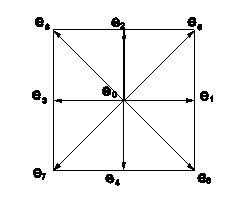
Figure 1. D2Q9 model
Please observe the Figure 1., you can find  and
and  , if we
define the
, if we
define the
horizontal line as x coordinate and vertical line as y coordinate.
Hence, we have  , where the subscribe i
is the coordinate x or y in 2D coordinates (x,y).
, where the subscribe i
is the coordinate x or y in 2D coordinates (x,y).
Please observe the Figure 1 again, you can find
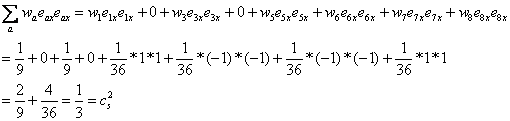 (1)
(1)
Similarly, You can also understand:
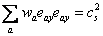 (2)
(2)
While:

(3)
Through above Eq.(1) and Eq.(2) and Eq. (3), you can understand
: 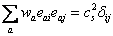 .
.
Hence, in similar procedure , it’s easy to understand the following Equation:
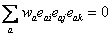 , (4)
, (4)
and
 . (5)
. (5)
Now, we finished the preparation for understanding the Taylor expansion in lattice Boltzmann. The following is the Taylor expansion:
Since  (6)
(6)
Substituting Eq.(6) into Eq.(A1), we can obtain:
 (7)
(7)
With help of and and Equation (4)
and Equation (5), we
have
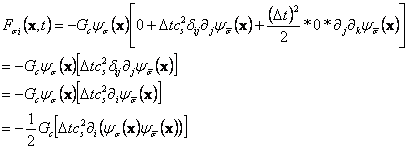 (8)
(8)
That’s the Equation (6) in Shan and Doolen’s paper (Journal of Statistical Physics, 1995).
According to Shan and Doolen’s opinion, using their Multi-component Multi-phase to recover NS equations:
 (9)
(9)
Compare with the object equation:
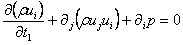 (10)
(10)
With the help of Equation (8) , usually
we using  and
and  , We can obtain the
following Equation of pressure:
, We can obtain the
following Equation of pressure:
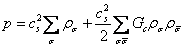 (11)
(11)
Hence, if the cohesion force is not Equation (A1) while the following (Shan and Doolen, 1995):
 (A2)
(A2)
FIRST CASE: 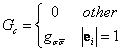 (Shan and Doolen, 1995) for their D2Q6 model, then
Because in their D2Q6 model  , Hence
In their paper the pressure is:
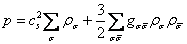
SECOND CASE: 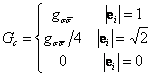 (Kang et al., 2002) for their D2Q9 model, then
Because in the D2Q9 model  , Hence
In their paper the pressure is:
THIRD CASE: 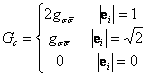 (Schaap et al., 2007) for their D3Q19 model, then
Because in the D3Q19 model  , Hence
In their paper the pressure is:

FOURTH CASE: 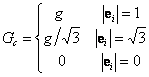 (Pan et al., 2004) for their D3Q15 model.
Because in the D3Q15 model  , Hence
In their paper the pressure is:
