MY RESEARCH INTERESTS
- Staining algorithm for modeling and migration
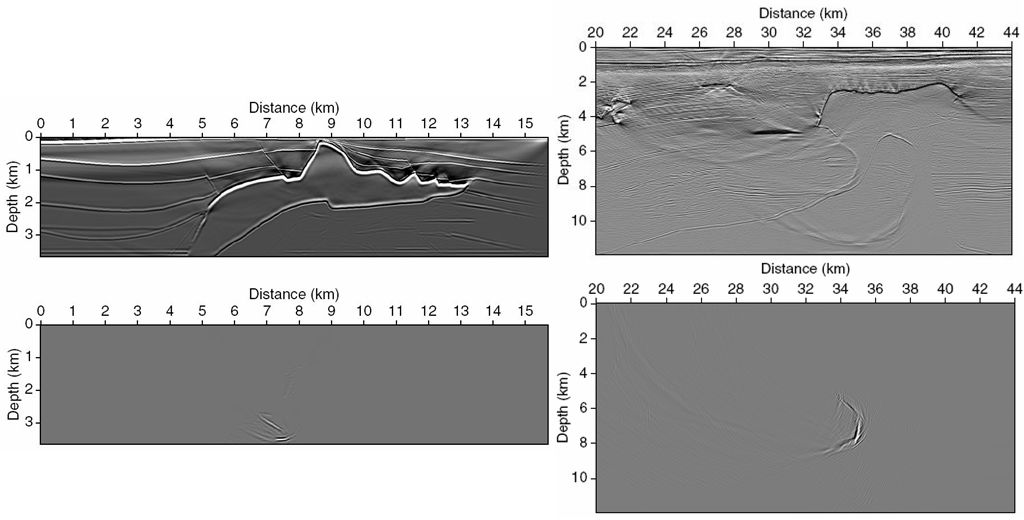
In seismic migration, some structures such as those in
subsalt shadow zones are not imaged well. The signal in
these areas may be even weaker than the artifacts elsewhere.
We evaluated a method to significantly improve the signal-to-
noise ratio (S/N) in poorly illuminated areas of the model.
We constructed a “phantom” wavefield: an extension of the
wavefield to the complex domain. The imaginary wavefield
was synchronized with the real wavefield, but it contained
only the events relevant to a target region of the model,
which was specified using a staining algorithm. The real and the
imaginary source wavefields were crosscorrelated with the
regular receiver wavefield. The results were revealed in
two images: the conventional reverse time migration image
and an image of the target region only. Synthetic experiments
showed that the S/N of the target structures was improved
significantly, with other structures effectively muted.
|
TOP: regular RTM; BOTTOM: staining migration (Li & Jia, 2016; Chen & Jia, 2014)
-
- Dynamic lattice method for modeling and imaging in TTI media
Different from wave-equation based
numerical methods, the dynamic lattice approach calculates
the micromechanical interactions between particles
in the lattice instead of solving the wave equation. We implement
Lagrange's equations to transform these interactions
into elastic forces acting upon each particle. By solving
the equations of motion, we obtain the disturbances of particles.
Therefore, seismic wave motions in continua are approximated
by displacements of these particles. Elastic
features of the continuum are represented by properties of
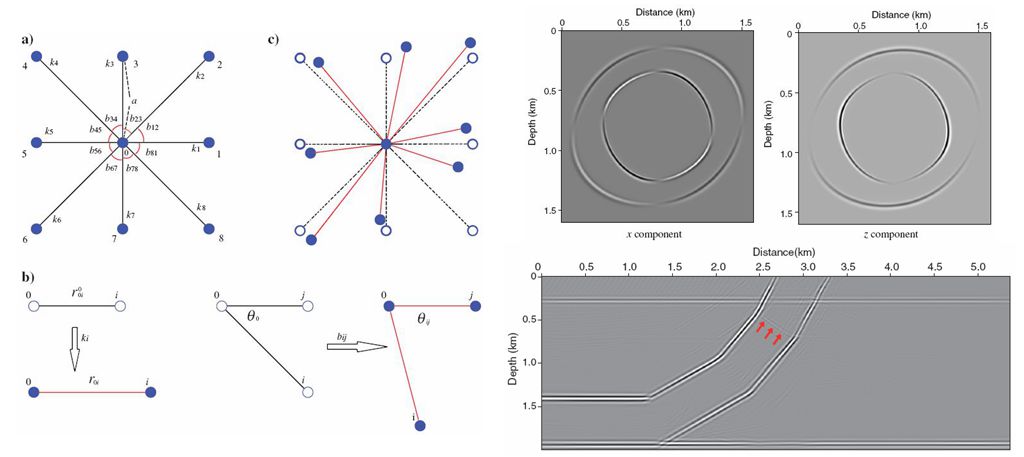
the particle lattice. Basing on such a particle lattice model, we make use of the orientations of the bonds in the lattice to create anisotropy. We have applied the method to reverse time migration on a TI model to test its usefulness in
complex media imaging.
|
LEFT: a lattice unit and bonds in it; RIGHT: modeling and imaging results in TTI media (Hu X & Jia, 2016)
-
- Numerical modelling & migration using frequency-adaptive meshes
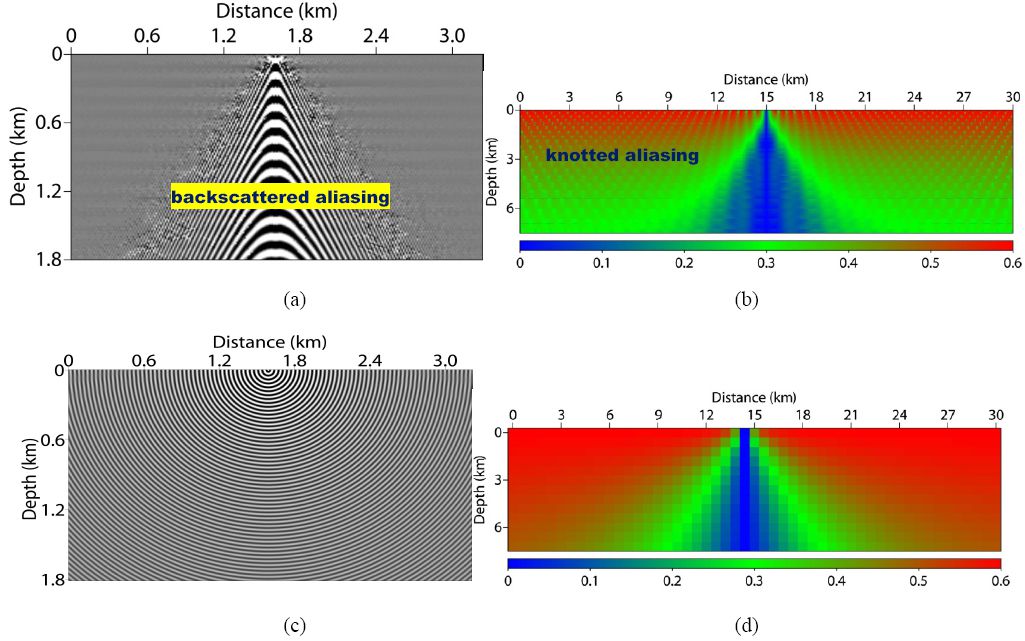
In regular grid-based methods, the mesh used for frequency-domain wave propagators is fixed for all frequencies. A too coarse mesh results in inaccurate high-frequency wavefields and unacceptable numerical dispersion; an overly fine mesh may cause storage and computational overburdens as well as invalid propagation angles of low-frequency wavefields. An improved modelling algorithm using frequency-adaptive meshes is applied to meet the computational requirements of all seismic frequency components. Experiments indicate that the adaptive mesh effectively solves these drawbacks of regular fixed-mesh methods, thus accurately computing the wavefield and its propagation angle in a wide frequency band.
|
(a) single-high-frequency wavefield with fixed grids; (b) single-low-frequency ray parameter with fixed grids; (c) single-high-frequency wavefield with adaptive grids; (d) single-low-frequency ray parameter with adaptive grids. (Hu J & Jia, 2016)
-
- GPU-accelerated element-free reverse-time migration
Element-free method (EFM) has been demonstrated successfully in elasticity, heat conduction and fatigue crack growth problems. Compared with the
finite element method (FEM), EFM is much cheaper and more flexible because only the information of the nodes and the boundary of the concerned area is required. However, due to improper computation and storage of some large sparse matrices, the
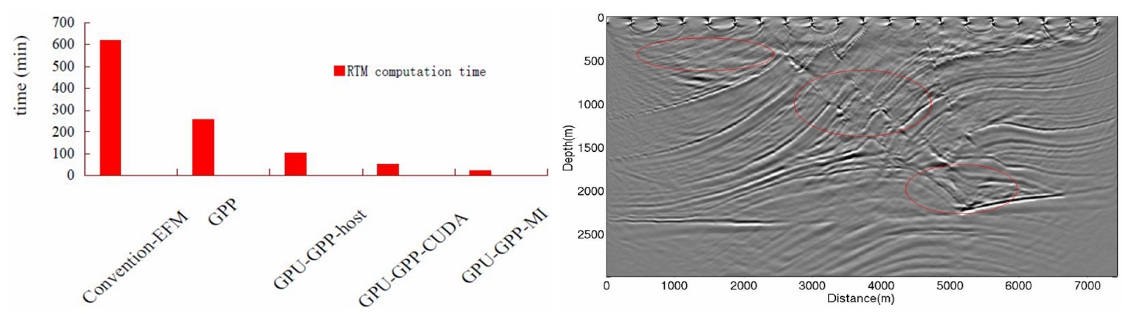
method is difficult to be applied to seismic modeling and reverse time migration for large velocity model. In order to solve the problem of storage and computation efficiency, we propose a concept of Gauss points partition (GPP), and utilize GPU to improve the
computation efficiency. Numerical experiments indicate that the proposed method is
accurate and more efficient than the regular EFM.
|
LEFT: computational time of RTM for Marmousi model; RIGHT: RTM result with EFM (Zhou & Jia, 2016; Fan & Jia, 2013; Jia & Hu, 2006)
-
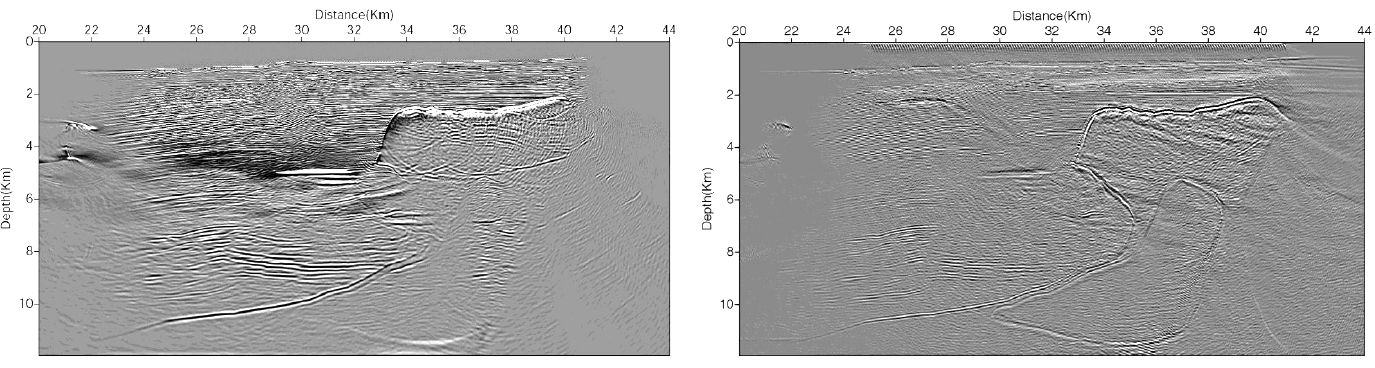
- 3D superwide-angle one-way method
Wavefront reconstruction method is proposed
in which two orthogonally propagated one-way wavefields are combined and interpolated.
This method has accurate super-wide angle (greater than 90 degree) propagation
and can model turning waves. Consequently, it has good performance in imaging
overhanging salt flanks. At the same time, the computational cost of this method is
twice as that of regular one-way method.
|
LEFT: regular one-way migration; RIGHT: superwide-angle one-way migration (Jia & Wu, 2009)
-
- Other numerical modeling methods
- Other one-way/two-way migration methods