skip to: page content | links on this page | site navigation | footer (site information)

Research Areas

Determining detailed structrues around the SAFOD site using advanced seismic imaging methods


San Andreas Fault Observatory at Depth

Building on more than 15 years of experience from the Parkfield Earthquake Experiment, the National Science Foundation (NSF) and the USGS started in June 2004 to drill a deep hole in order to install instruments directly within the San Andreas Fault Zone near the initiation point of previous magnitude 6 Parkfield earthquakes (drill hole location in relation to slip rate). These instruments, set 2 to 3 km beneath the Earth's surface, will form a San Andreas Fault Observatory at Depth (SAFOD). This project will directly reveal, for the first time, the physical and chemical processes controlling earthquake generation within a seismically active fault.


Drilling the hole for SAFOD starts west of the San Andreas Fault and then use advanced directional-drilling technology developed by the petroleum industry to angle the hole through the entire fault zone until relatively undisturbed rock is reached on the east side. Fault-zone rocks and fluids will be retrieved for laboratory analyses, and geophysical measurments will be made within the active fault zone. SAFOD's long-term monitoring activities will include detailed seismological observations of small to moderate earthquakes and continuous measurements of rock deformation and other parameters during the earthquake cycle.


Determining Target Earthquakes For Drilling

    • Thurber, C., S. Roecker, H. Zhang, S. Baher, and W. Ellsworth (2004), Fine-scale Structure of the San Andreas Fault and Location of the SAFOD Target Earthquakes, Geophys. Res. Lett., 31, ?doi:10.1029/2003GL019398.

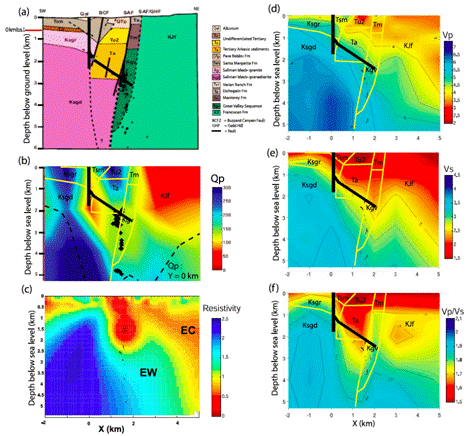
Detailed velocity models around the SAFOD

    • Zhang, H., C.H. Thurber, and P. Bedrosian (2009), Joint inversion for Vp, Vs, and Vp/Vs at SAFOD, Parkfield, California, Geochemistry, Geophysics, Geosystems, 10, Q11002, doi:10.1029/2009GC002709.

Shear-wave splitting analysis around the SAFOD

    • Liu, Y., H. Zhang, C. Thurber, and S. Roecker (2008), Shear wave anisotropy in the crust around the San Andreas fault near Parkfield: spatial and temporal analysis, Geophys. J. Int., 172, 957-970.

Shear-wave splitting anisotropy tomography

    • Zhang, H., Y. Liu, C. Thurber, and S. Roecker (2007), Three-dimensional shear-wave splitting tomography in the Parkfield, California Region, Geophys. Res. Lett., 34, L24308, doi:10.1029/ 2007GL03195.

Scattering Imaging around the SAFOD

    • Zhang, H., P. Wang, R.D. van der Hilst, M.N. Toksoz, C. Thurber, and L. Zhu (2009), Three-dimensional Passive Seismic Waveform Imaging around the SAFOD site, California, Using the Generalized Radon Transform, Geophys. Res. Lett., 36, L23308, doi: 10.1029/2009GL040372.

Joint Seismic and MT imaging

    • Bennington, N.L., H. Zhang, C.H. Thurber, and P. A. Bedrosian (2012), Joint inversion of seismic and magnetotelluric data in the Parkfield region using the cross-gradient constraint, Geophysical Journal International (in review).