|
|
|
The
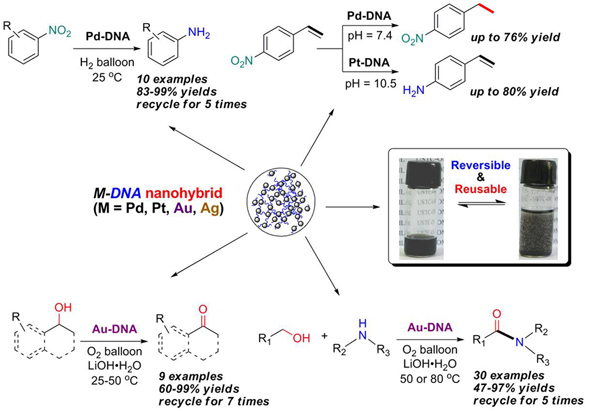
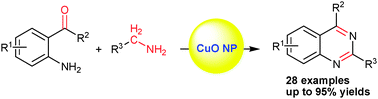
preparation and catalytic application of heterogeneous catalysts: |
|
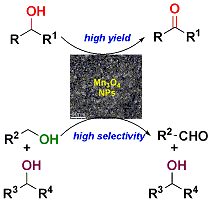
Various metal and metal oxide NPs
are prepared and used in organic reactions as heterogeneous catalysts. Natural templates
and artificial
templates can be used to regulate the size, shape and catalytic
activity of NPs. Our investigations focus on these
areas:
(1) the effect of the supporting environment of
natural templates
or artificial templates on the reaction activity and selectivity.
(2)
the effects of the size and shape of NPs on the reaction activity
and selectivity. |
Angew. Chem. Int. Ed.,
2011,
50,
8917-8921
Chem. Commun.,
2010,
46, 7912–7914
|
|
|
Chem. Commun.,
2010, 46, 5244–5246
Adv. Synth. Catal. 2012.
Accepted

Dalton.Trans,
2009,
43, 9363-9373 (review)
|
|
Chem. Eur.
J.,
2011, 17, 8630-8642
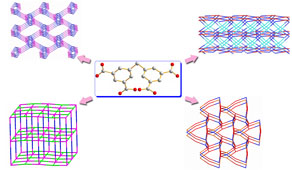
Cryst.Eng. Commun.,
2011, 13, 1646-1653
Cryst.Eng. Commun.,
2011, 13,7236-7245
|
|
Tridentate
ligand-metal complexes catalyzed asymmetric reactions: |
|
|
|
Amino acids and their derivatives have constituted one of the
most popular chiral sources for asymmetric catalysis, since they are
readily available and could afford an array of structurally related
compounds to facilitate tuning of both rates and selectivities in
catalysis.
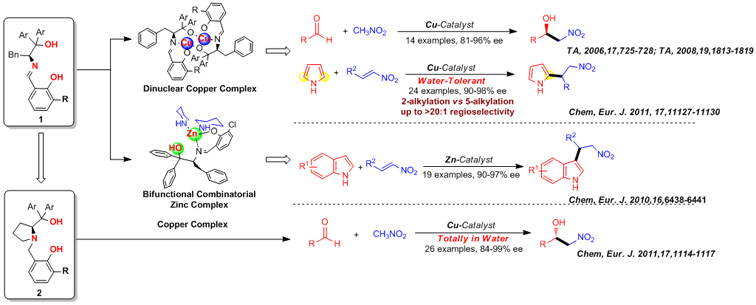
Tridentate ligands (ONO-ligands) derived from amino alcohols
with 2-hydroxybenzaldehyde derivatives have been shown to be a class
of promising ligand for many asymmetric reactions. Our efforts are
focused on the development of new tridentate ligand-metal complexes
with robust reactivity and novel activation modes.And these
complexes may be used under very mild reaction conditions, such as in
water.
 |
|