

Research
Main content
Active matter systems, composed of self-propelled particles that consume energy to generate motion, are intrinsically far from equilibrium. We study the collective behaviors of such systems — including motility-induced phase separation (MIPS), active diffusion in complex environments, and pattern formation — by combining large-scale simulations with nonequilibrium statistical mechanics theories. A central theme is understanding how activity reshapes phase diagrams and transport properties compared to equilibrium counterparts.
Representative results are given as follows:
Activity-induced droplet inversion in multicomponent LLPS
In cells, liquid-liquid phase separation (LLPS) often involves active components driven by energy input. We developed a phase-field model for three-component LLPS with one active component and found that activity can invert the droplet morphology: the equilibrium B-A-C layered structure transforms into C-A-B upon sufficient activity. This work provides a basic model for understanding nonequilibrium phase separation processes in living cells.
 J. Chem. Theory Comput. (2025).
Dynamical and thermodynamical origins of MIPS
We introduced a coarse-grained mapping method to probe detailed balance breaking in the density-energy phase space, revealing the dynamical and thermodynamical origins of MIPS based on landscape-flux theory. The nonequilibrium probability flux splits the single potential well into two, demonstrating that it is the dynamical origin of MIPS. Meanwhile, a scaling transition of entropy production rate provides a thermodynamic indicator for the phase boundary.
 Cell Rep. Phys. Sci. 5, 101817 (2024).
Effective diffusion of a tracer in active bath
Using a path-integral approach, we derived an analytical theory for the effective diffusion of a passive tracer in an active bath. The theory captures how active particles enhance tracer transport through persistent kicks, providing quantitative predictions verified by simulations. This framework offers insights into intracellular transport where molecular motors create an active environment.
 Natl. Sci. Open (2024).
Motility-induced phase separation is reentrant
Activity can create effective attractions leading to MIPS in purely repulsive active Brownian particles. We discovered a counterintuitive reentrant behavior: MIPS disappears at sufficiently high activity due to activity-induced nonequilibrium vaporization. A kinetic theory analysis reveals that this reentrance is a purely nonequilibrium effect absent in any equilibrium system, highlighting the essential difference between active and passive phase behaviors.
 Commun. Phys. 6, 58 (2023).
Rod-assisted heterogeneous nucleation in active suspensions
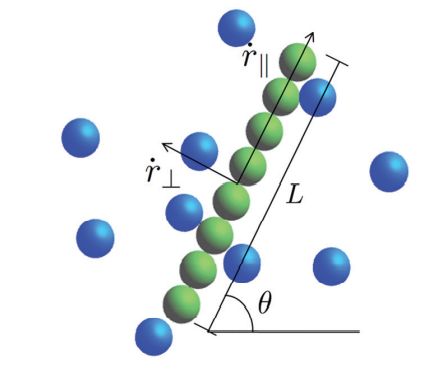
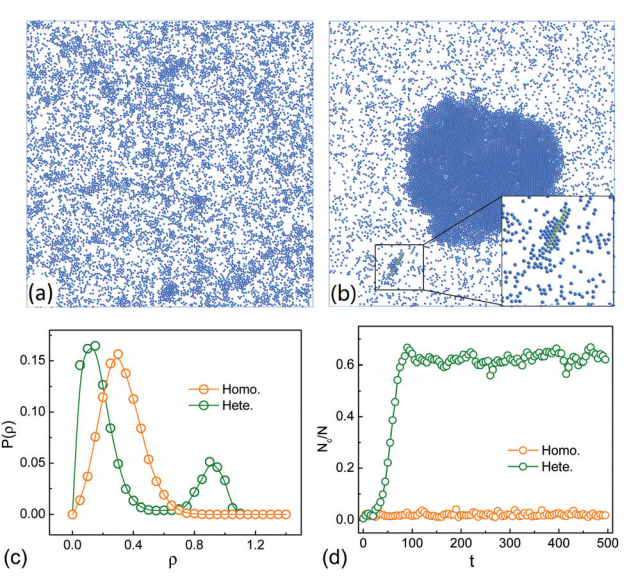
We studied the heterogeneous nucleation process of active Brownian particles by introducing a rod-like passive seed. Such a seed can exponentially accelerate the nucleation rate and readily induce phase separation of a dilute active system. Interestingly, the phase behavior is re-entrant with activity: single-phase states exist at both high and low activities, with phase-separated states in between.
 Soft Matter 16, 6434–6441 (2020).
Active particle in polymer solution
We studied the diffusion behavior of an active Brownian particle in semidilute polymer solution and found a non-monotonic dependence of the diffusion coefficient on particle size — it increases first and then decreases.